

Departing Katherine was accompanied by mixed feelings. Relief (that we were able to leave), Anxiety (can we trust our vehicle again?) & pleasurable anticipation which always accompanies a new adventure.
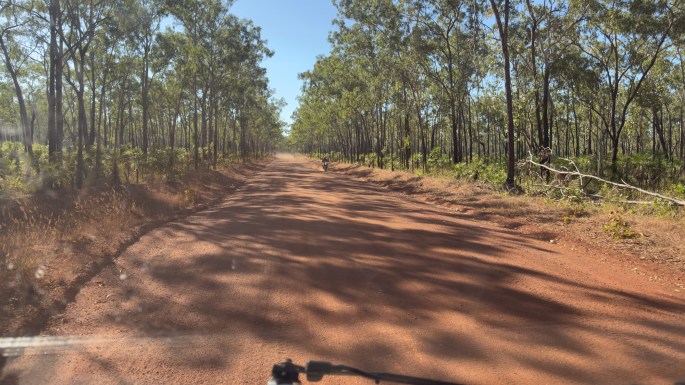
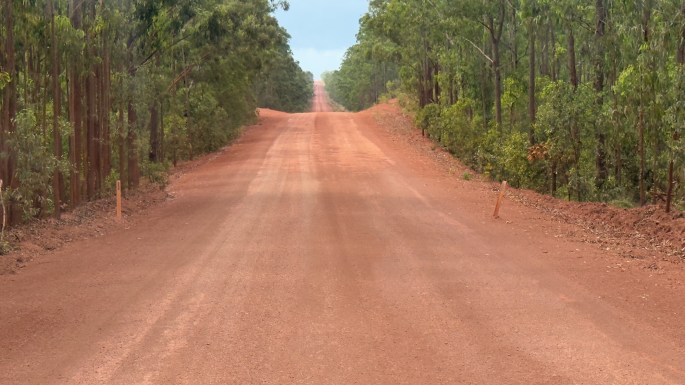
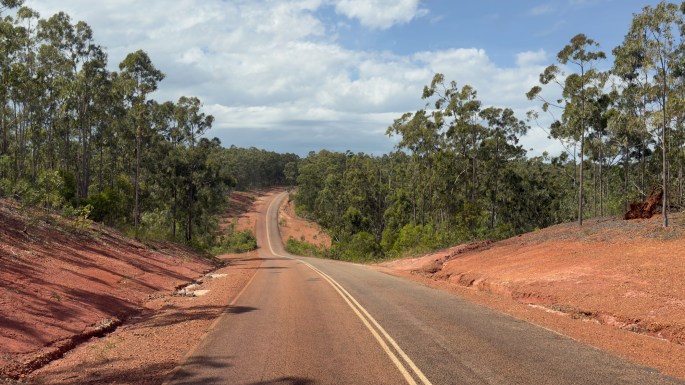
And this was indeed a new adventure, around 1500kms there & back with all bar 120kms on unsealed roads. All of it ‘virgin ground’ for us.

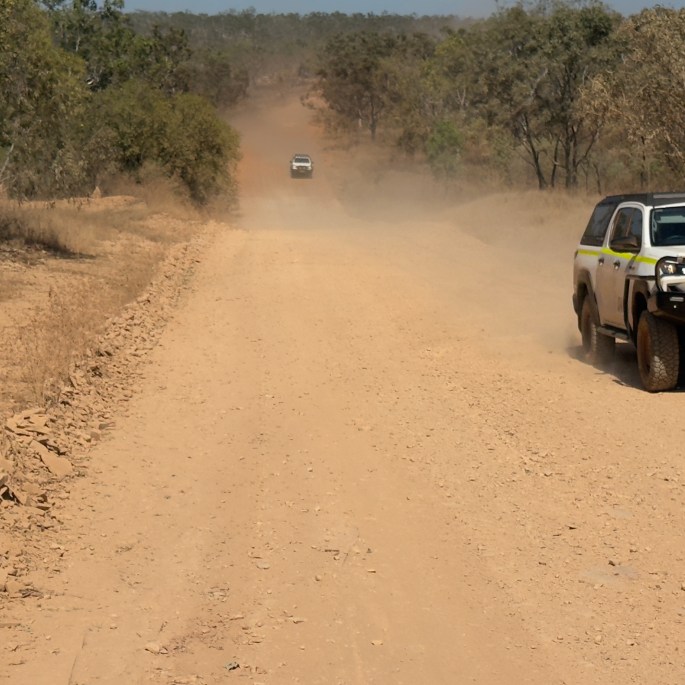


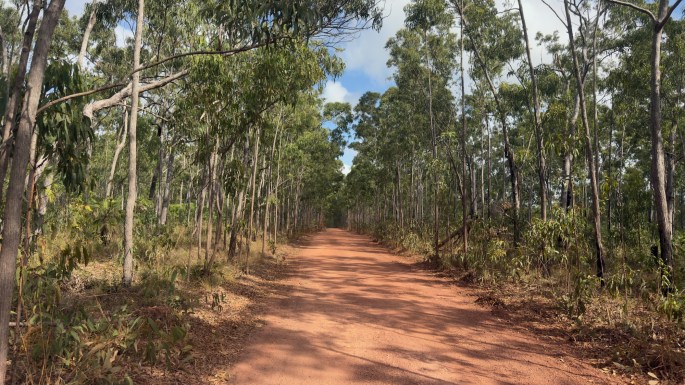
For our readers in the UK the Central Arnhem Road has no services along the way other than a single small campground at around the 250km mark. There are several aboriginal communities along the route , but these are closed communities requiring additional permits to enter. We feel sure that if in dire need help could be sought from these communities but their resources are very limited – we certainly couldn’t expect, for example, for there to be a mechanical workshop. The closest most such communities come to that are their old dead cars which function as a parts store to be cannibalised.


I recall that on one occasion in the past being asked by an English friend when we were caught in a severe lightning storm 200kms from the nearest town, “Why didn’t you just stop at a motel for the night?” It seemed beyond their comprehension that not only were there no handy motels, there was nothing. The only sign of human endeavour being the red dirt road behind us & in front of us. No power poles, fences let alone buildings. This time almost the entire distance would be through untouched tropical forest of varying densities on both sides of the road. Forest covering 97,000 square kilometres with a population of around 16,000 dotted through it, 25% of which live in the mining owned & built town of Nhulunbuy on the far north east coast. (think of an area about 75% of England, but with a population of less than 0.03% of England!) The rest live in tiny remote communities & family ‘homelands’. Most of these are closed to tourists, & rightly so we feel. They don’t need folk peering at their lives like exhibits in a zoo. A few however have chosen to accept tourists for both income and as a means of educating visitors about traditional culture.

Negative impacts from whitefella culture have been strong here as in all of Australia, but there are some notable differences in Arnhem Land compared to the broader Australian picture. The primary differences are that the disruption to traditional living, racist attitudes & alcohol came much later here. Not until the 1970’s when the bauxite mining was established, when whitefellas took traditional lands without consent, protests from Elders went unheard, turning important food gathering & traditional ceremony lands to lay forests bare with bulldozers, scraping the bauxite ore to make aluminium & imposing ‘foreign’ culture. At the same time building a whole new town & port to support the mine & it’s workers. For the first time alcohol was introduced with the construction of the ‘Walkabout Hotel’ (which still runs today).
Times have changed, the RioTinto mine is soon to close, & with it a likely departure of a good proportion of Nhulunbuy’s population, & services. At present collective groups of aboriginal clans are taking on some of the services, but East Arnhem is facing a very unclear future beyond 2029 when Rio Tinto depart. The town’s only food supply (Woolworths) has set a departure date for next year (2027). All supplies come in by barge. Future food security is at best uncertain. Tourism is hoped to be a significant part of East Arnhem’s future, but of course not all are happy about this. Folk who live out in the tiny remote homelands & small communities whilst still living traditional cultural lives to a great extent, have of course developed varying degrees of dependence on white man culture. Many divide their time between ‘on country’ living & town living, be it in Nhulunbuy, or the nearby communities of Yirrkala (a ‘mission’ town) a mixed community of Rirratjiŋu and Gumatj clans. Gunyangara (a small island close to Nhulunbuy – accessible via a causeway) primarily a Gumatj clan community.
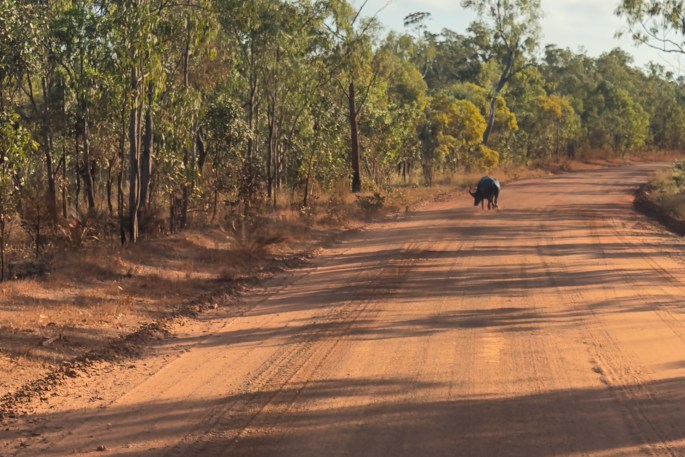
Buffalo represent a real danger to humans, right across Arnhem Land (& in some other parts of the Northern Territory). Often when out in the bush we would see their very large piles of dung & could smell their scent, but thankfully never encountered one whilst on foot. We did see a sign somewhere warning of their danger & giving advice on what to do if confronted by one. “Don’t look at them & back quietly away, trying to put a barrier between it & yourself (like a tree). Climb the tree for safety. (Obviously this was advice for younger fitter folk than us). If the buffalo keeps coming toward you & you have no physical barrier to hide behind DO NOT RUN, DO NOT MAKE ANY SUDDEN MOVEMENTS OR NOISES. Lay down flat on the ground and cover your head. We can only imagine how much courage would be required to take that advice!


So apart from the colonising being far more recent (due to the remoteness of the area & the forests not being what pastoralists wanted to run sheep or cattle), the most significant difference to much of Australia is that aboriginal folk living here were not rounded up & taken away from their lands, so a much stronger connection to country (& thus culture) remains. That sense of belonging is important & folk are understandably protective of this.
This is the country where the world renowned musicians like Yothu Yindi, Gurrumul & King Stingray have contributed much to an awareness of Yolgnu culture & local cultural pride. Colonising damage has been done, scars are deep, but generally self-esteem remains more intact than elsewhere in Australia. It’s not hard to see a negative picture, but hope & strength are also on view. Just like the future of the ‘post mining’ mining town the cultural future of the many clans within the Yolngu ‘umbrella’, is a mix of hope & uncertainty.
So what was the attraction for us to make the long, dusty & bumpy journey out to East Arnhem?
Well firstly it took us several years to accept a compromise, that being unable to visit in the way we would have liked to. We had tried over time to find ways to spend an extended time in Arnhem Land, in the hope of perhaps living within a community for at least a year, time to get to know people, to establish trust & learn about & share what is important. Sadly the only way to get a longer term permit for something like this is to get a job, not only something we as retirees don’t want, but also because we have no wish to be seen either as ‘experts’ going in to tell people how to live, or to promote the sense of ‘you need us to do this for you (promoting dependence), or going as volunteers. This carries similar risks, but it turned out that volunteering is tied up with a number of ‘do-gooder’ and/or religious based organisations. And the amount of ‘red-tape’ was very off putting, particularly for folk who travel full-time as we do. Expectations to undergo pre-volunteer’ activities & courses across the country were just not practical.
So we finally accepted that the only way we could visit would be as tourists or not at all. Secretly we had a little hope that maybe, just maybe, we might get lucky & establish a relationship once there which might lead to an invitation to stay longer in a small community or homeland. Now in hindsight we realise just how unrealistic that was. Trust which has been abused isn’t suddenly rebuilt in a few days regardless of how well meaning we might be. It makes us realise how privileged we have been to have been able to spend time with & alongside other aboriginal communities elsewhere.
We would have also have liked the opportunity that a few friends had years ago. To explore further afield, but today permits ensure that much of Arnhem Land remains well out of tourist reach.We would be restricted to the Central Arnhem Road & approved campgrounds within about a 50km radius of Nhulunbuy. We believe that communities & homelands further south, & along the north coast have been impacted by the establishment of Nhulunbuy far less, & understandably wish to keep it that way. A difficult balance, & this only serves to heighten our interest & curiosity, but we accept that if we were in the shoes of folk who live there we too would want to protect what we have.
Of course another part of the attraction was the adventure of getting there, & the photos we had seen of beautiful coastlines & swimming holes.
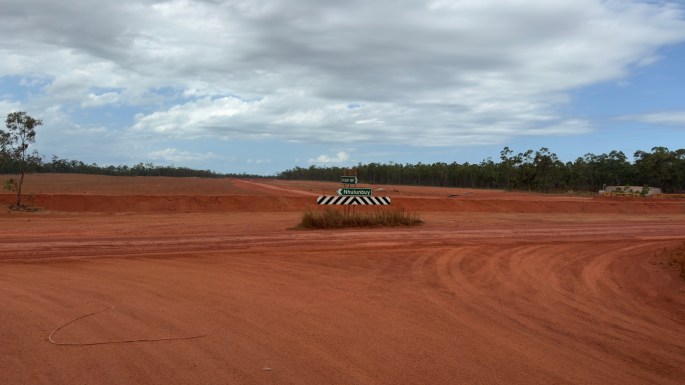
Transit Permits to drive on the Central Arnhem Road are issued by the Northern Land Council, based in Darwin. A bureaucracy who set the rules. Stay only on the road, nowhere else. And the only approved camp spot is at Mainoru Outstation. 250 kms from Katherine. The expectation is that the 450 or so kms from there to Nhulunbuy be done in a single day, regardless of road conditions. The worst corrugations of the trip extended for around 150kms east of Mainoru, seeing our speed often down to 20 or 30kph, shaking fillings & bouncing boobs! This would have meant a minimum driving time for us to reach Nhulunbuy of at least 8 hours or more. Generally we rarely drive more than 200-300kms in a day, & on these rough roads where concentration is constant 300km would be a ‘big day’. 450 was unthinkable. We had been told about a good riverside camp spot, a now bypassed section of the original road, next to a creek crossing (now replaced by a bridge a few kms away). Upon arrival it was quite clear we were far from the first to use this spot, being located at around the 2/3rd mark of the journey. Later whilst in Nhulunbuy we heard that although not ‘official’ it is indeed commonly used. The Tourism people in town put out a survey on what could be done better whilst we were there. We responded suggesting an additional ‘approved’ camp spot on the way in. This garnered the approval of quite a few looking at the survey.
You might remember that we had had to cancel a number of the camp bookings we had made due to our delayed departure from Katherine. The online booking service said refunds were available, but the web site said otherwise when we tried. However phone contact with the permit folk at Dhimurru Aboriginal corporation proved a very different story. The ladies there were fantastic, very helpful & we were refunded all our cancellations in full. And on our first night, whilst at the Mainoru campground we managed to get in contact with a couple living & working in Nhulunbuy who needed pet sitters to look after their two dogs & a cat for 3 weeks, whilst they attended a family wedding & fitted in a weeks holiday in Bali. We agreed to the sit, subject to getting our ‘on country’ permit extended. They assured us it wouldn’t be a problem & when we went to the Dhimurru office we found they were correct. Not only did the Dhimurru ladies change the dates of our original 1 month permit to suit our arrival date, but they were also happy to issue a second permit to follow it. So what had, in our minds been a 2 week visit (cut back from an initial 4 weeks) , but now we could stay for up to 2 months. In the end we stayed 6 weeks. Our advice to others heading out to east Arnhem on a standard 1 month permit, who would like to stay longer, is that provided you have somewhere to stay it is very possible. There are always cancellations at the camp spots (& a facebook group dedicated to just this) so if you are flexible enough to take sites when they are available (&/or house sit – we saw several opportunities arise whilst we wee there) it’s not hard to stay for longer. This felt quite different to the picture formed from afar.
So we had a couple of weeks camping, three weeks house sitting, & a further week of camping. Access to a few of the highly desirable camp spots along Cape Arnhem, plus Little Bondi & Turtle Beaches was not possible for us due to low trees over the tracks to access them. Again the Dhimurru ladies had been helpful, letting us know where we could go/not go with truck height of 3.2m. Disappointing, but they had shared this info at the time of our initial bookings just before Christmas ’25. Still some great spots to go to though. Rather than listing them our photos & video can tell the tale.


We were welcomed by Elder Timmy Burrawanga, who said ‘this is your home’. If his surname sounds familiar, it is the same as the lead singer of the Warumpi Band, George Burrawanga, the musician I most wish I had had an opportunity to see perform, but didn’t. I think Timmy told me he was a nephew when I asked. Another musician who was there was on his homeland was Ngalaka ‘Billy’ Wanambi, lead singer for the now world renowned surf rock band King Stingray. East Arnhem punches well above it’s weight, musician-wise given it’s small population. He was a very confident, but modest young man, clearly well connected to & appreciative of his culture. A responsible role model for the younger boys
There were a couple of politicians visiting whilst we were there, not people I have a lot of liking for, who were grabbing much of the family’s attention by virtue of promising funding to improve the community’s water supply, but Timmy made sure to include us in some of the activities put on for them. This included a feast of turtle eggs, collected that morning. In turtle nesting season fresh tracks made by the turtles coming up the beach are sought out & followed with the searcher poking a long thin stick into the sand to find where the eggs have been laid. Not all the eggs are taken, but neverthless the morning’s haul from 3 different nests was more than 100 eggs. Much the same size as a chicken egg, but round & with a leathery white ‘shell’, even after being boiled. All were boiled in a large pot over the fire. There are traditional rules about how the eggs are distributed but we were offered as many as we wanted. One was sufficient for me, I’m a bit of a woose when it comes to trying new unknown foods, so felt quite proud of myself that I gave it a go. Taste-wise – imagine a slightly fishy chook egg, quite rich, & not awful. The texture was the bit I struggled with, the yolk was more ‘chalky than a chook egg) & even after having been well boiled, the egg white, remained liquid but tasted much the same as chook ‘egg white’.
Some of the politicians visitors , a group from an Israeli charity, (who would be providing the water upgrade funds) got some ‘healing’ to help them feel better about parting with their money, but again Timmy & his wife Rita ensured all present were included.
At night Timmy and Grace (a grand daughter) sat with us around the fire with Grace cooking mud mussels she had collected from the mangroves that day, & sharing them with anyone who wanted to try. Not me matey! But MrsTea had one. An acquired taste I believe, which apparently improved with the chewing.
As you can see in the video getting there was a bit of an adventure getting there, with the final 4 or 5 kilometres driven along the soft sand beach. Prior to going we had been given instruction to lower tyre pressures to 20 psi, before getting on the beach, with the warning that the sand was softer & deeper once we turned off the beach just before Bawaka. We had enquired if we would be ok with our 7 tonne truck & the answer had be ‘Probably, but no guarantees, & if you get bogged we only have a troopie here”. You can see from the video that the OKA managed just fine. We only dropped tyre pressures to 25psi all round, the 20psi being a recommendation for lighter vehicle. We cruised along the beach in low range , 3rd gear, but needed 1st & 2nd low once off the beach. The Allison auto transmission really makes sand driving so much easier than with a manual gearbox.
The house-sitting in Nhulunbuy was a good experience. The owners were lovely down to earth folk, whom we felt valued by from our very first meeting. Their two Staffies, Kal & Letty were characters whom we enjoyed walking, both around town & on the nearby beaches regularly. We had a small car to get around for this purpose. Mai, the cat, was unlike any cat we have met previously. Very affectionate (on her terms), but more like a dog than any cat we have ever come across. Often pushing our arms with her nose for a cuddle, (no tumy rubs though, any attempted tummy rub brought an instant swipe of a claw), an expert in opening doors & really quite a character who grew on us. Kal, the younger of the two dogs was quite impetuous, & when given attention, rarely knew when to stop, like a kid with ADHD. The difference however, was when he was allowed to just be with us he would settle quietly alongside us, even on a lap, so long as we then ignored him. One pat, stroke or even a look, & and he was like a bottomless pit of attention seeking, wanting more & more love & affection. He had plenty of both. 🙂 Letty was a bit older & wiser, so less pushy & easier to cuddle. MrsTea loved painting all 3.

Nhulunbuy houses were all built by the mining company, in 3 stages over the years. Each stage house shares the same footprint/layout to all the others. Most are rented & rent includes power & water, plus servicing of the utilities & air conditioners. Just as well as the airconditioners in each room *have* to stay on 24/7. Windows are to be kept shut. The Italian (I think) company contacted to build the houses back in the 70’s clearly didn’t understand tropical conditions, when they produced the concrete blocks on site to construct the houses with. Experience over the years has demonstrated that the only way to prevent mould from taking over is to keep all windows shut & all the aircon units running 24/7. The windows were screwed shut, & we heard stories of some houses where if the aircon were turned off, it would automatically come back on within a few minutes. We just followed the owners instructions & left ours on & became used to experiencing the heat & humidity when going outside. A few houses have been bought by owners from Rio Tinto. One or two ahve real estate ‘For Sale signs outside them. We wondered what the chances of a sale will be in these times of uncertainty for the community. Some houses contain a lot of asbestos & we understand that these will be demolished as they become vacant. “Our’ house had warning stickers on painted asbestos panels saying not to disturb.
The weather for what is considered to be mid dry season had an apparently unusual amount of rain during the 3 weeks. At least twice a week, quite heavy, but brief falls, long narrow lines of it coming in off the Arafura sea, missing most of Arnhem, just passing over Nhulunbuy & surrounds. Even a short drive out of town on the very red dirt roads resulted in our truck becoming very red, almost up to the roof line. Cleaning was a big job with a broom & hose, but leaving the bauxite to bake on in the sun would have resulted in a bigger job. We only used the small car within the sealed road limits. Plenty of vehicles around town had what we imagine would be permanent red staining.
The Nhulunbuy opshop must vie with our favourite in Broome as the best we have found in Australia. In Nhulunbuy it only opens on Saturday mornings & everything is the same price. $2 per item & with a *lot* on offer. We enjoyed the weekly Saturday morning ritual visit, along with many others & left town with a different ‘wardrobe’ to what we arrived with.
The ‘town centre’ is an overstated term where Nhulunbuy is concerned. There is Woolies (small with narrow aisles &l imited range of stock … eg tomatoes. Only large tasteless ones. When we asked if the get the smaller punnets of ‘cherry tomatoes we were told they were generally lucky to get any & that what they had was a bit of a luxury) a chemist & a take away food shop. That’s about it. Nearby is the only fuel station, & further afield a couple of hardware stores, post office, cafe & bakery. All of them could probably fit into the space that the public pool takes up next door to the Walkabout hotel. Walkabout has camping too. $75 a night described as beach side. It sort of is if you first get a key from reception to open a gate & then walk a distance. The beach can’t be seen from the hotel grounds. A little further out from the centre is the surf club – a bar with a nice lawned area in a pretty beachside location, monthly evening markets are held there & are worth perusing & getting a feed. Quite a few green public spaces around town plus sports fields. Out of town further, hidden in the forest are an industrial area which also houses a few private health practitioners. (In addition to the hospital in town).The boat club (with a campground & restaurant), a skate part, bmx park, speedway track are all within a few kms, oh and the golf club set between the outskirts of town & beaches. We met a few folk here & there & picked up on quite a strong sense of community, one where folk will pitch in to help each other out. A high proportion of houses had boats parked in the driveway. Overall our town time was a good experience but not somewhere we would choose to live long term, although that said, with a few ‘connections’ made we can understand why some feel very attached to the place, but most , we suspect, view life in Nhulunbuy as ‘temporary’, albeit for a few years. Everyone we met had properties elsewhere in Australia to return to some day.
I got to this point in creating this post & decided to experiment with something different. A slideshow created in my Mac Photos software rather than adding way to many photos here in the text. Initially I uploaded it directly to here, but doing so significantly downgraded the photo resolutions So I then exported to Youtube. Please feel free to let me know if you think if you think it better to have lots of individual photos or a slideshow like this. NB. I know about the nonsensical captions on photos – nothing to do with me, it is Youtube AI trying to be clever & failing. Just turn off ‘Captions’ in the Youtube settings – not sure why it has defaulted to being on.
Yirrkalla, is about 20kms from Nhulunbuy in a lovely beachside location. Although it showed signs of neglect it was a place we warmed to. The art centre & museum were a real surprise. From a very unassuming exterior, the interior was top class, as good if not better than any galleries we have been to before. The art was exemplary, but also very expensive. We are not art connoisseurs, but very much enjoyed discussing with each other what pieces we liked & why. Perhaps I am a connoisseur, my favourite was a large piece which turned out to have the highest price tag we saw. $35,000 ! Paintings, carvings, etchings , exquisite weaving, yidakis (didgeridus) & ḻarrakitjs (decorated hollow log coffins). I wish I had asked if it was ok to take photos, but I took none. Better still was the incorporation of museum. A separate audio-visual theatre running a looped video telling the story of the arrival of the mining & the impact upon the local population, with a lot of footage from back in the 70’s. Sad, but really interesting. Of note were two large wall hangings once painted by many people from all the Yolngu clans & hung in the church either side of the pulpit. Later removed because the then pastor thought them ‘heathen’. We met Leon whilst we were eating a pie from the freshly decked small store, he was sitting outside with his walking frame waiting for a lift back to his house, an elderly fella who worked as the school principal & lived in Yirrkala for many years. He introduced himself asking if we had seen the two wall hangings before telling us he chap who had broken into the church & recovered the wall hangings which he found languishing & covered in mud wasp nests some years back. They have since been restored & really are magnificent. If you visit East Arnhem, 100% go to the art centre/Museum. It *will* blow you away. We asked Leon if it were ok for us to walk down to the beach. “Yep, you’re good people” he said, “if anyone asks just tell them I said it was OK”
Our return journey back to Katherine was punctuated with the same overnight stops as on the way in, although we found much of the road had been graded & was in much better condition. Still some rough patches, but overall a lot easier on us & the truck. Although we hoped for another Water buffalo encounter to film on the way out, we saw only the same group of young tamer ones near Mainoru we had seen on the way in.
Arriving back at the Stuart Highway about 45kms south of Katherine, it felt again like we had just transferred from one country to another. Sealed dual carriage highway, big road signs & much faster traffic. We settled into out usual highway speed 85kph & felt like we were going very fast, despite vehicles coming past us at up to almost double our speed (legally – 130kph speed limit). We pulled into an overnight rest area, quite pleasant, among trees & with a loo. Just as well as we had discovered that our toilet (Thetford PortaPotti 345) no longer had a functioning flush. Investigation revealed that an internal hose from hand pump to bowl had split & come adrift. Not repairable without the hands the size of a 5 year old. Only option was to buy a new one. $250 for the sake of a $2 hose. Poor design, but even more irritating is that we have another one back home. We needed to replace with the same model to fit our storage space. Phone calls (via our Starlink – no phone signal this far out of town) found us the only two available in Katherine, they put our name on one & we collected it next morning, after shopping/restocking, & refilling with fuel & water. A nice surprise after getting fuel, was for the 2135kms we had driven to, from & around East Arnhem was that we had achieved a ‘best to date’ average fuel consumption of 17.48litres per 100kms (a tad over 16mpg) which we think pretty good for a 7 tonne truck with the aerodynamics of a brick.
Katherine is a town we are always happier to leave than to arrive, so once we had what we needed we moved on. The question was which way. North or south? Previously we had planned to go north, to re-visit Kakadu NP to visit spots not previously seen, en route to Garig Gunak Barlu (Cobourg Peninsula NP) in North Arnhem Land. This would mean crossing the Cahills Crossing on the poorly named East Alligator River. (Poorly named, not only because we don’t have alligators in Australia, but also because the section of river around this crossing is known to have one of the densest populations of very large crocodiles in Australia, & at this time of the year when many water holes are drying up, the numbers in the river increase).
The problem currently is that the road to the Cobourg peninsula (& the park itself) have been closed for most of this dry season due to infrastructure & road damage caused by 2 cyclones earlier this year. The road & the park finally opened recently on August 7th but with a vehicle weight restriction of 4.5 tonnes. Our weight is 7 tonnes. As of yesterday (20th) the 4.5t limit still applies. We have decided to go up to Kakadu, slowly & hope that perhaps in 2 weeks time the weight restriction might be lifted. The lady at the Parks dept in Darwin is doing a good job of keeping us informed & managing our ‘prospective booking made months ago. Fingers crossed. We are moving into the hotter part of the year, & don’t want to be up there beyond mid to late September. Find out if we get there in our next post.
Regards
Cuppa & MrsTea.
Hi cuppa, we are currently at Lorella Springs wilderness park for 2 more days. The owners may be interested in some company for their adult son who is being left here while they go off for the Wet. (08)8975 9917
Hi Al, thanks for thinking of us. Years ago it was an ad for wet season caretaking at Lorella which got us dreaming of remote wet season sits. This year we think we will take a break from the heat & humidity & are now southbound with a hope of finding winter sits to enable us to spend a year or so over in Tassie.
Magic, as usual, ya lucky bastards. We’ve been stuck in Melbum since June last year while the little lady’s ongoing health problems (knee and hip ops) settle down. Hope to get away in a few months for a quick sojourn around dinosaur country, then after summer set off again for another year away. Hopefull, anyway. Maybe catch you two out there. In the meantime, I’ll keep being jealous through your posts. Gerard (Badger)
Thank you for another entertaining instalment! I loved the slideshow at the end of the Bawaka Homelands clip. As for the other slideshow, I agree with the general consensus that having the photos within the body of the post is better for context.
Mrs Tea is certainly a very talented artist and the pet owners must have been impressed also and very happy with her gift to them.
I’m glad the rig performed well this time.
Safe travels,
Sue
Thanks once more, Cuppa. I have repeatedly put my email on the list for receiving notifications, but never get one! Perhaps the system rcognises me and puts me in the “junk” area automatically?
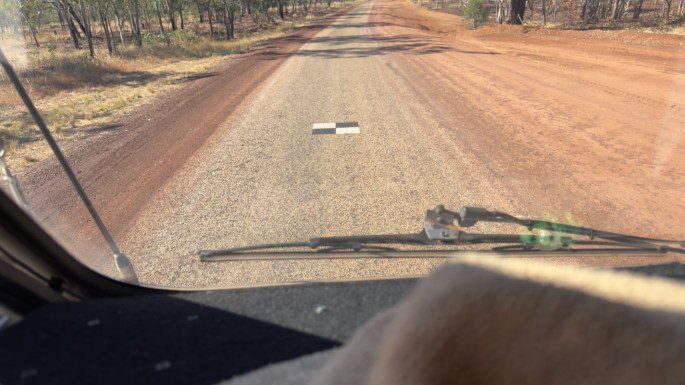
On a different not (AI) states: The black and white checkered squares painted on or near roads are Ground Control Points (GCPs) used by surveyors for aerial mapping, drone photography, and LiDAR data collection.
Stay well, cheers, Mark
Thanks Mark. I have emailed you.
Regards
Cuppa
Thanks Cuppa and Mrs Tea. We really get excited when another of your travel emails arrives in our inbox.
Arnhem Land really is another world and we very much appreciate you “taking” us there.
We do prefer the photos and your videos to be interspersed in your narrative.
Keep enjoying your travels and thanks again for a wonderful post.
You wrote another book one wants to read from beginning to end right away! Great again! As for the black an white squares, first thing I thought but cant be right: checking speed from the air 😉 as they do on other roads.
Cheers,
Willem
Hi Willem, A reader emailed me (Thanks Ross) to say “Those [Black & White squares] are (almost certainly) reference points for aerial photography/satellite pics/GPS etc
Another ripping yarn.
I come from the Top End and grew up in what is now Kakadu, so a lot of the terrain is familiar. Worked in Nhulunbuy too, so know the area well.
Now living “down South” and reading this in a cold Winter makes me homesick.
On a different note, while my husband was recovering from serious surgery recently I read aloud to him your last trip report. He found it fascinating. Especially all the mechanical woes. LOL
What a wonderful, wonderful story ( and photos). This deserves to be published for all to see. I was astounded that Arnhem land covered most of England and Ireland and even encroached in the Atlantic Ocean.
Hi Cuppa and Mrs Tea, as always I love getting the email bringing stories of your latest adventures and thoroughly enjoy reading them. We too have spent time in East Arnhem and loved it. We also prefer camping in the bush and It was great to see photos of many of the places we visited, now 8 years ago. Returning there is still high on our list…
Regarding your photos I think I prefer them dotted throughout your story. Going to YouTube in order to watch them “full screen” felt a bit clumsy and I also felt like I lost the thread of your story. You are such a great storyteller and it seemed that the technology invaded the pleasure I have of hearing those stories.
Thank you for the energy you put into writing for us.
Thanks David, I appreciate your feedback & I think you are right. I’ll give the slideshow a miss in future.
Loved your pics again (as usual) . One thing baffled me – the repeated reference to “Heat. Heat” throughout the video??
Hi Al Mac, it puzzled me too! Was nothing I did. Drove me nuts for a while, but I eventually worked it out. For some reason YouTube has defaulted to having captions on and obviously guesses at sounds it hears, even when there is no speech. In YouTube settings you can turn off ‘captions’ and the’Heat Heat’ nonsense goes away.
Another great read, hoping to get to Garig Gunak Barlu next year with the Tvan. Finally got to Kutini-Payamu this last month and stayed ay Cooks Hut And Chilli per your recommendation. Rained a lot at Cooks and the walks were closed and Chilli was windy as usual, but spotted a couple of palm cockatoos at Chilli which was a highlight. Enjoy your travels and hope the Oka continues to behave.